
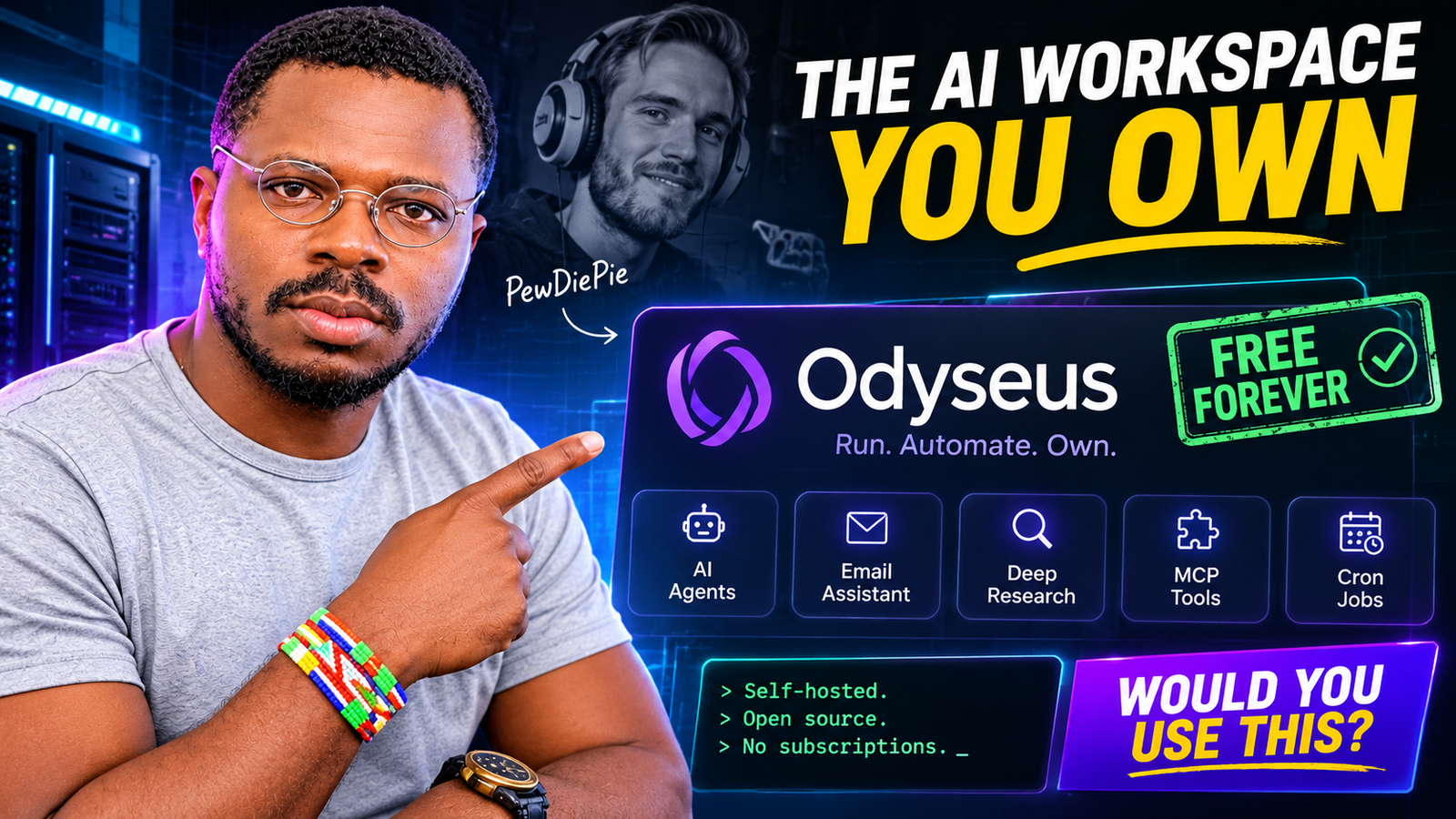
Can one of YouTube's biggest creators make local AI more accessible than the tech industry itself?
When you hear about someone building an AI workspace with autonomous agents, persistent memory, local models and automated workflows, you'd probably expect a startup founder or an experienced software engineer.
Not PewDiePie.
Yes, the YouTuber.
His latest project, Odyseus, is an open-source, self-hosted AI workspace designed to give people access to powerful AI tools without locking them into another monthly subscription.
And there's quite a lot going on under the hood.
A personal AI workspace without another subscription
Odyseus brings several AI capabilities into one environment. Rather than jumping between different platforms and paying for separate services, users can run and manage AI agents from a single workspace.
It includes persistent memory, self-evolving skills, customizable chats, multiple AI models and support for MCP connectivity.
There's also an email assistant that can summarize messages, generate replies that match your writing style, organize emails with tags and help identify spam.
Then there's the deep research feature. It can carry out multi-step research tasks, gather information from different sources, read through them and synthesize the findings into reports.
The interesting part isn't necessarily that these features are new. It's that Odyseus is bringing several of them together in a self-hosted environment.
STEP 1: SCAN YOUR HARDWARE
One feature worth paying attention to is the Cookbook.
Instead of expecting users to understand GPU memory, model sizes and local inference requirements before getting started, Odyseus helps simplify the process.
The Cookbook analyzes your hardware, recommends AI models that your machine can run and helps you install them locally.
That's a meaningful step towards making local AI less intimidating.
There are hundreds of models to explore, and users can choose what works for their hardware and needs.
Of course, not everyone has a powerful computer capable of running large language models locally.
Odyseus accounts for that too.
You can connect cloud AI APIs, meaning you don't have to abandon models that require more computing power. You can combine locally hosted models with cloud-based services depending on what you're trying to accomplish.
STEP 2: PUT YOUR AGENTS TO WORK
This is where things get more interesting.
Odyseus isn't just about chatting with AI. It supports agents that can carry out tasks and workflows.
You can configure scheduled jobs using cron, allowing agents to run at specific times without needing you to manually start every task.
Think about having an agent perform research overnight, periodically check information or execute a workflow on a schedule.
You can even access your workspace from your phone, making it easier to interact with your setup when you're away from your computer.
It's the kind of functionality that makes AI feel less like a chatbot and more like an assistant that can actually get things done.
STEP 3: THE CONTROVERSY
Not everyone is impressed.
Some developers have criticised the project, with discussions on Hacker News questioning how much original engineering went into it.
The criticism largely centres on the idea that Odyseus is a Python-based interface bringing together existing open-source tools rather than introducing entirely new underlying technology.
And that's a fair conversation to have.
Open source doesn't automatically mean groundbreaking engineering, and putting existing tools behind a polished interface isn't the same as inventing those tools.
But I think there's another side to this story.
A huge part of the AI ecosystem remains inaccessible to everyday users. Terms like Ollama, MCP, local inference and autonomous agents can sound like an entirely different language if you're not already involved in the developer community.
PewDiePie has an audience that extends far beyond that community.
By introducing these concepts to millions of people, he's potentially bringing local AI to an audience that might never have explored it otherwise.
And rather than keeping the project closed, Odyseus is open source, giving developers an opportunity to inspect it, improve it and contribute.
That doesn't mean every criticism should be dismissed. It simply means the conversation should consider more than whether the underlying technology is entirely original.
So, is Odyseus worth paying attention to?
I think so.
Not because it has invented a completely new category of AI, but because it represents something worth watching: the democratisation of AI infrastructure.
The future of AI might not be entirely about having the smartest model or the biggest subscription plan. It could also be about giving people the freedom to choose their models, control their data, build their own workflows and decide where their AI actually runs.
Odyseus is an interesting experiment in that direction.
There are still practical questions around setup, reliability, security and how well all its integrations work in everyday use. Those are things worth testing rather than assuming away.
But the bigger question is whether projects like this can make self-hosted AI genuinely accessible to people outside the developer community.
And perhaps that's the part of this story worth paying the most attention to.
Would you run your own AI workspace, or would you rather keep paying for cloud-based AI subscriptions?